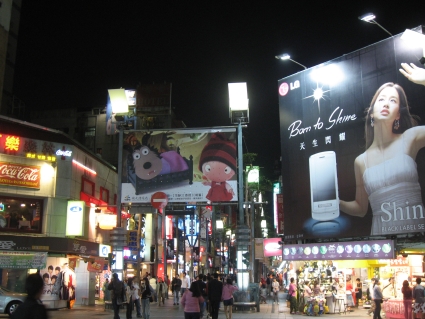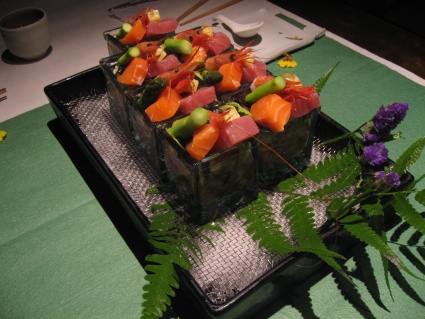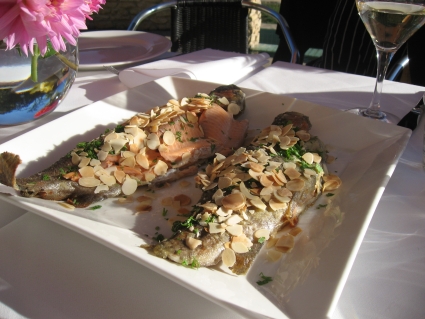
Da Shan Wu Jia, Taipei

Tuna and salmon sashimi

Mention to people that you’re heading overseas and you’ll often be bombarded with all manner of advice regarding places you simply must visit while you’re there.

Sometimes these recommendations uncover hidden gems, secret spots you’d never have stumbled across on your own. Other times they turn out to be complete duds. You spend all day hunting them out and it transpires that the place has either closed down, changed hands or never existed in the first place (Mali? Oh, I’m sorry; I thought you said you were going to Bali).

Despite being burned before, I still find it hard to resist the anticipation that accompanies heading to a place that has been scribbled on a scrap of paper and doesn’t appear in any of the guidebooks.

Shortly before a recent trip to Taiwan, I was given a red-hot tip for a restaurant just outside the capital, Taipei. A colleague’s friend had dined there last year and reckoned it was in the same league as Sydney’s Tetsuya’s but one-third of the price. It sounded like an ambitious claim. Last year Tetsuya’s was named as the fifth best restaurant in the world by London’s Restaurant Magazine, and was awarded the top accolade of three chefs hats by The Sydney Morning Herald Good Food Guide. It would be fair to say I was curious but sceptical.

Read the rest of this story here.
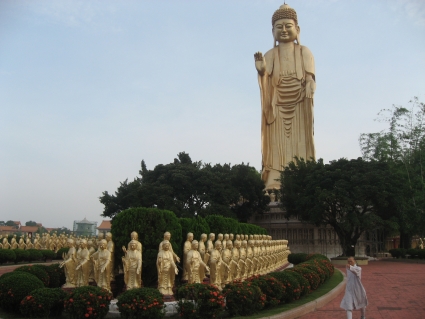
Overnight stay in Fo Guang Shan monastery, Taiwan

Great Buddha Land in Fo Guang Shan, Taiwan - photo by Rob McFarland

It’s a magical, if slightly surreal, moment. We’re standing in the courtyard of the largest Buddhist monastery in Taiwan, surrounded by 480 identical gold statues of Buddha, listening attentively to the softly spoken words of one of the monks, the Venerable Yi Jih. The early evening light is just starting to fade and there’s not a breath of wind.

Suddenly, a mobile phone rings. Some of us tut disapprovingly and look around accusingly for the culprit. To our amazement, the offender is Yi Jih. She apologises while rummaging comically beneath her flowing orange robes to locate her phone. After a short conversation, she declares that the monastery office is closing soon so we’d better be quick if we want to check our emails.

And there was me thinking that technology was the root of all evil.

Read the rest of this story here.
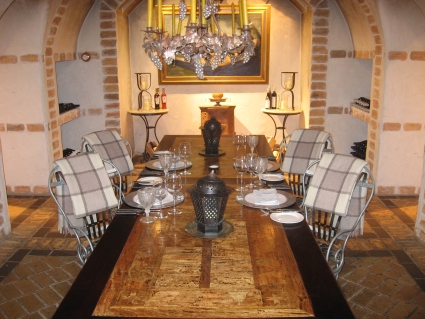
Heavenly Huka Lodge

Dinner in Huka Lodge's Wine Cellar - photo by Rob McFarland

It’s not quite the first impression I had hoped to make. Not only do we pull up at the reception of one of the world’s leading resorts in a dented rented Daewoo but two minutes after our arrival the manager comes to tell us they are experiencing what he amusingly describes as a small challenge.

The keys are locked inside the car and did we have a spare set? I sheepishly shake my head. Do not worry, he says, we will take care of it.

Ten minutes later the car is in the car park and our luggage is in our room. Later we discover that the Automobile Association has been called in but no one makes a big deal about it and we are made to feel as if this is the sort of trivial incident they encounter on an hourly basis

Read the rest of this story here.

Watching the beautiful game in Buenos Aires

Corner kick during Velez vs Internacional

When I ask Barney, our Argentinian guide, which football team he supports, his voice takes on a low, serious tone. “Normally I support Boca Juniors,” he replies, looking round conspiratorially, “but tonight I will support the local team, Velez.”

After I jokingly suggest that I’m going to cheer for Sport Club Internacional, their Brazilian opponents, a look of sheer horror crosses his face and for a moment I think he might throw me off the bus.

Clearly, “futbol” is not a subject to be joked about in this part of the world.

Read the rest of this story here.
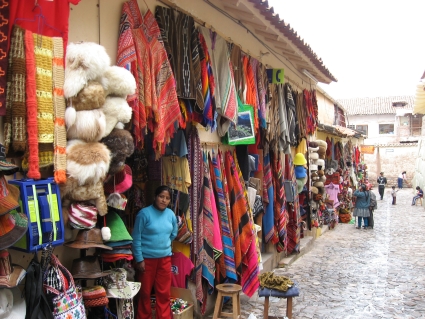
Cusco, Peru

Market stall in Cusco - photo by Rob McFarland

I’ve never been so apprehensive about getting off a plane. After spending most of the flight from Lima to Cusco reading about all the possible symptoms of altitude sickness, I’m convinced I’m going to faint theatrically the second they open the door.

I don’t. I venture nervously out onto the stairs and take my first breath of oxygen-starved Cusco air. And then a second. And then a third. The relief is palpable. I’m going to survive.

Read the rest of this story here.
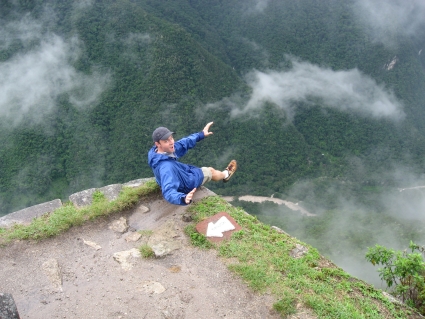
Climb to the top of Wayna Picchu, Peru

Climbing to the top of Wayna Picchu - photo by Rob McFarland

Winner, 2007 ASTW Travel Writer of the Year
Winner, 2007 ASTW Best International Story (over 1000 words)

I’m having second thoughts. The steep stone path we’ve been slowly climbing up for the last half an hour has disappeared and we’re standing on a small section of terracing with terrifying thousand-metre drops on three sides. Maybe this really wasn’t such a good idea. Maybe we should have heeded the advice of the security guard who told us not to carry on.

Suddenly, Rob (the only other person on the tour foolish enough to attempt this with me) spots a small sign pointing into what appears to be a sheer rock face. Further investigation reveals a hole and, after using our camera flashes to illuminate the entrance, we discover a tunnel. We exchange a “what the hell, we’ve come this far” look and I follow him in. On the other side is another flight of breath-sapping steps but the end is finally in sight. We edge around a large boulder, climb a small wooden ladder and join a handful of other elated climbers on what feels like the top of the world.

Read the rest of this article here.

Coast to coast in Auckland

Cornwall Park in Auckland

There can’t be many cities in the world where you can set off from an ocean on one side and four hours later be standing looking out across a sea on the other. Auckland’s 16-kilometre Coast to Coast walk threads its way from Waitemata Harbour on Auckland’s east coast to Manukau Harbour on the west, taking in some of the city’s most scenic spots along the way.

It’s a great way to spend a morning or an afternoon, providing, that is, you have someone who can read the map supplied by the tourist information centre.

Read the rest of this story here.

Partying on the Zambezi

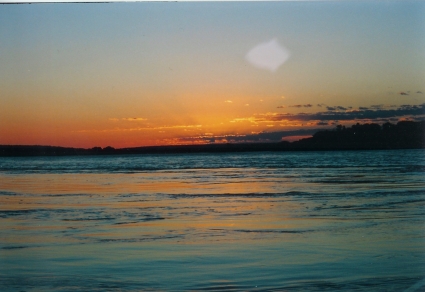
Sunset over the Zambezi

Sitting at the bar wearing a traditional Russian fur hat, I’d just ordered a beer from a Keith Richards lookalike in a large stetson. To my right a girl was trying to decide between a tiara and a trilby, while on my left the American Indian, the biker and the soldier from the Village People looked worryingly close to breaking into a chorus of YMCA.

As dress codes go, it was certainly one of the more unusual: to get served at the bar, you had to be wearing a hat. Fortunately, there was a large range to choose from hanging up on the wall, but it wasn’t exactly the sort of thing I’d expected to encounter on a small island in the middle of the Zambezi River.

Read the rest of this story here.
Dan Brown fans invade Rennes-le-Chateau

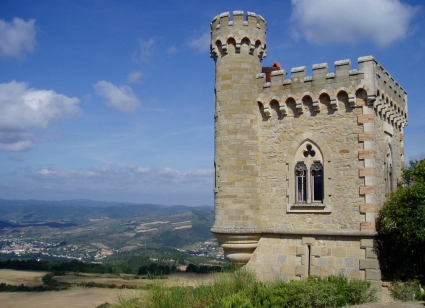
Magdala Tower at Rennes-le-Chateau

Dan Brown has a lot to answer for. While the upper echelons of the bestseller lists may be enjoying a respite from The Da Vinci Code, a small village on a hill in southern France is having no such luck.

Nestled in the foothills of the Pyrenees in the Languedoc region of France, the tiny hamlet of Rennes-le-Chateau is being overwhelmed by camera-wielding tourists. There was a time when you could drive up the narrow road that winds carefully to the village without passing another car. Nowadays, the odds are you’ll be trailing a convoy of coaches crammed full of amateur historians.

All of which is a bit strange given that Rennes-le-Chateau is never actually mentioned in The Da Vinci Code. Where it is mentioned, though, is in The Holy Blood And The Holy Grail the book from which Dan Brown took many of his most controversial claims. First published in 1982, it never enjoyed the same stratospheric success as The Da Vinci Code, but it still made the bestseller lists and caused a maelstrom of controversy among church figures.

Read the rest of this story here.